


v1.0.0 — Durable consumer-group semantics over searchable stores.
Backends: Mnesia (single-node disc_copies), Redis Streams, MongoDB,
PostgreSQL / SQLite (host-owned Ecto.Repo), and ETS (ephemeral). Rheo
is an Elixir/OTP library you embed in your supervision tree, not a standalone
messaging server. Consume with Rheo.Consumer or feed a Broadway pipeline
with Rheo.Producer.
Delivery guarantee: at-least-once. Duplicates are possible after failures — use stable event IDs for idempotency. Ordering is guaranteed within a partition only (not globally across partitions).
From 1.0, the public surface (Rheo / Rheo.Consumer / Rheo.Backend and
the HexDocs freeze inventory) follows Semantic Versioning.
Breaking changes to that surface require a new major version; each release
ships with a migration guide when behaviour changes.
When to use
Use Rheo when you want:
- An immutable, queryable event log in a database you already run
- Consumer groups with leases, ACK, retry, and dead-lettering
- Competing consumers and independent groups on the same stream
- Partitions with key routing, a contiguous ACK frontier, and
Rheo.lag/3 - SQL backends via a host-owned
Ecto.Repo(PostgreSQL or SQLite) - A durable source for Broadway/GenStage instead of a second broker
- OTP-native demand, concurrency, and lease renewal — without standing up Kafka, RabbitMQ, or a separate broker cluster
Skip Rheo when you need a dedicated broker (massive fan-out, cross-language clients, exactly-once claims) or when a simple job queue is enough.
Compared with other approaches
| Approach | Strengths | Trade-offs |
|---|---|---|
| Rheo + MongoDB | Searchable history + durable groups in one store; embeds in OTP | At-least-once only |
| Rheo + PostgreSQL | Uses the database you already run; jsonb event log you can query in SQL; SKIP LOCKED claims across nodes | At-least-once only; you own the repo and migrations |
| Rheo + SQLite | Durable with no service at all; same API | Single node only (distributed: false) |
| Rheo + Redis Streams | Native PEL / reclaim; several BEAM nodes on one group | Requires Redis 6.2+; history search is secondary |
| Rheo + Mnesia | Durable ETS-shaped store without Docker; same API as ETS | Single-node disc_copies in v0.11 (distributed: false) |
| Rheo + ETS | Same API with no Docker/DB; great for tests and Livebook | Ephemeral — data dies with the owner process |
| Kafka / Pulsar | Huge throughput, mature ops, many languages | Separate cluster; history search is not the primary model |
| RabbitMQ / NATS | Classic messaging, routing | Not an immutable searchable event log |
| Oban / Broadway alone | Great job/pipeline DX on Elixir | Different problem: jobs/pipelines, not durable consumer groups over an event log — so Rheo feeds Broadway rather than replacing it (Rheo.Producer) |
| Raw Mongo change streams | Live updates | No leases, ACK fencing, competing groups, or retry/DLQ |
Databases already store and search historical events well. Message brokers already coordinate consumers well. Rheo combines those strengths: immutable, queryable events in a store you run (MongoDB, PostgreSQL/SQLite, Redis Streams, or Mnesia), with leases, acknowledgement, retry, and competing consumers in OTP.
Installation
Add Rheo to your mix.exs dependencies:
def deps do
  [
    {:rheo, "~> 1.0"}
  ]
end
Optional integrations
Rheo core needs only telemetry and jason; ETS works out of the box. Add
the dependencies for the integrations you use and the matching modules are
compiled:
| Dependency | Enables |
|---|---|
{:mongodb_driver, "~> 1.5"} | Rheo.Backend.Mongo |
{:redix, "~> 1.5"} | Rheo.Backend.Redis (Redis 6.2+) |
{:ecto_sql, "~> 3.11"} + {:postgrex, "~> 0.19"} or {:ecto_sqlite3, "~> 0.17"} | Rheo.Backend.Ecto, mix rheo.ecto.gen_migration |
{:gen_stage, "~> 1.2"} | Rheo.Producer |
{:broadway, "~> 1.2"} | Rheo.Broadway and its acknowledger |
Then fetch deps:
mix deps.get
Choose a backend:
# Zero-infra (tests, Livebook, ephemeral apps)
{Rheo, name: MyRheo, backend: Rheo.Backend.ETS}

# Durable MongoDB
{Rheo, name: MyRheo, backend: {Rheo.Backend.Mongo, url: "mongodb://localhost:27017/rheo"}}

# Durable SQL on a repo your app already supervises (PostgreSQL or SQLite)
{Rheo, name: MyRheo, backend: {Rheo.Backend.Ecto, repo: MyApp.Repo}}
Quick start
ETS (no Docker)
children = [
  {Rheo, name: MyRheo, backend: Rheo.Backend.ETS},
  {MyApp.RiskConsumer, rheo: MyRheo, concurrency: 8, max_demand: 100}
]

Supervisor.start_link(children, strategy: :one_for_one)
MongoDB
children = [
  {Rheo, name: MyRheo, backend: {Rheo.Backend.Mongo, url: "mongodb://localhost:27017/rheo"}},
  {MyApp.RiskConsumer, rheo: MyRheo, concurrency: 8, max_demand: 100}
]

Supervisor.start_link(children, strategy: :one_for_one)
PostgreSQL or SQLite (Ecto)
Your app owns the repo; Rheo borrows it and never starts the pool:
children = [
  MyApp.Repo,
  {Rheo, name: MyRheo, backend: {Rheo.Backend.Ecto, repo: MyApp.Repo}},
  {MyApp.RiskConsumer, rheo: MyRheo, concurrency: 8, max_demand: 100}
]

Supervisor.start_link(children, strategy: :one_for_one)
Create the five rheo_* tables with a migration (preferred in production, so it
runs once under your release's migration step):
mix rheo.ecto.gen_migration --repo MyApp.Repo
mix ecto.migrate
Rheo.ensure_indexes(rheo: MyRheo) also creates them idempotently on boot. Pass
notify: true for a PostgreSQL NOTIFY rheo_events wakeup hint, or
prefix: "rheo" to keep the tables in their own schema. On PostgreSQL,
metadata and payload are jsonb, so the event log stays queryable in plain
SQL. See ADR 017.
Define a consumer — handlers implement handle_event/2 and return an outcome;
the local Rheo.Group started by the child spec owns fetch, concurrency, lease
renewal, and settlement:
defmodule MyApp.RiskConsumer do
  use Rheo.Consumer,
    stream: "market-events",
    group: "risk",
    concurrency: 8,
    max_demand: 100

  @impl true
  def handle_event(event, _context) do
    case Risk.process(event) do
      :ok ->
        :ack

      {:temporary_error, reason} ->
        {:retry, reason}

      {:permanent_error, reason} ->
        {:reject, reason}
    end
  end
end
Create a stream, append events, and query history:
Rheo.create_stream("market-events")
Rheo.create_group("market-events", "risk")

Rheo.append("market-events", %{
  type: "curve_update",
  currency: "EUR",
  price: 2.913
})

Rheo.query("market-events", type: "curve_update", currency: "EUR")
Interactive walkthroughs (open from a clone in Livebook):
| Notebook | Focus |
|---|---|
| Index | Links to all demos (HexDocs) |
| Quickstart | ETS publish / fetch / Consumer |
| Concepts | Leases, search, replay, partitions |
| Ops | Inventory, lag, group health, dead letters |
| LiveDashboard | Control panel + real Rheo LiveDashboard via Phoenix Playground |
| Pipelines | GenStage, Flow, Broadway |
| Backends | ETS, Mnesia, Mongo, SQLite, PostgreSQL |
Ops control & LiveDashboard
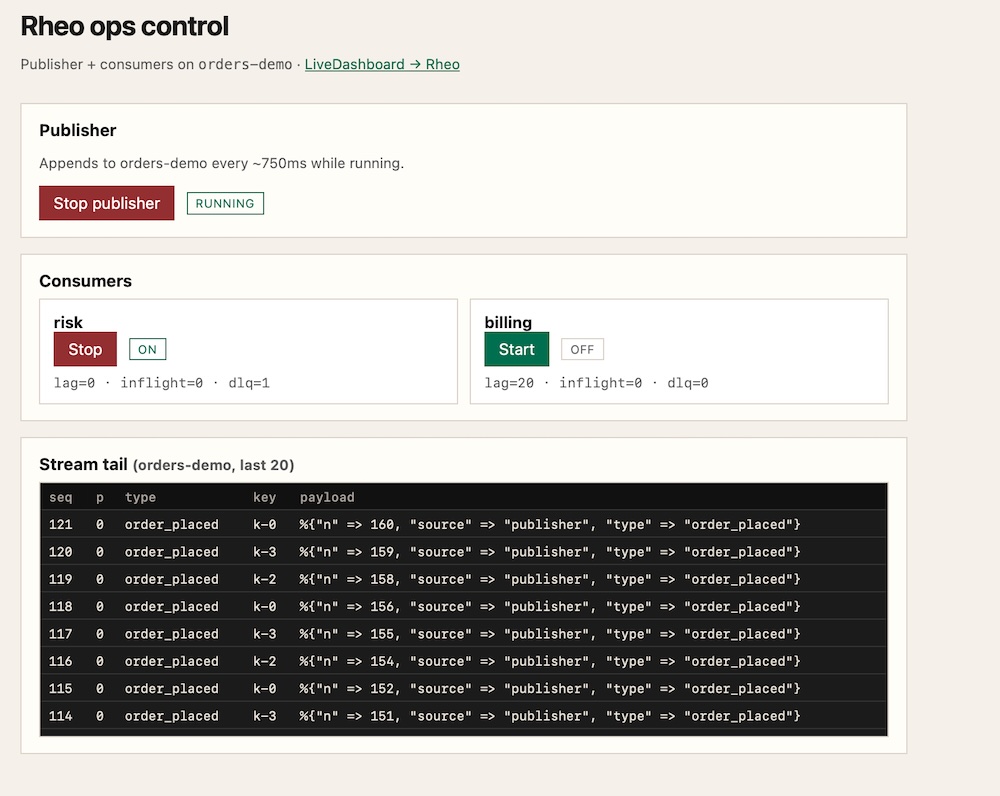
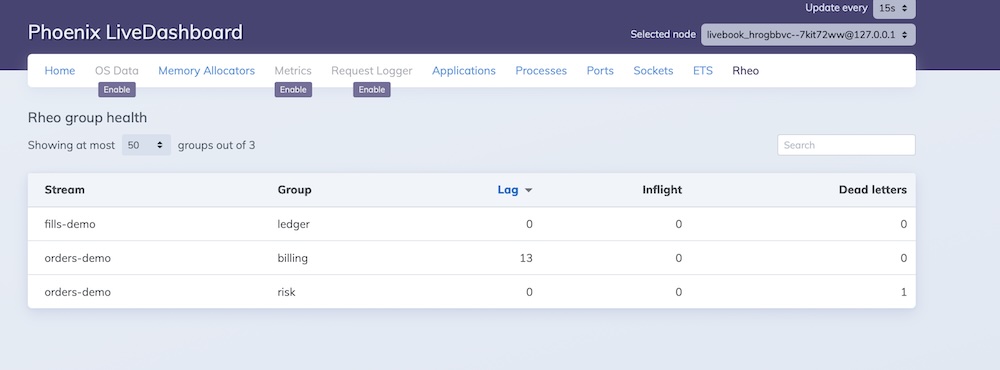
Playground demo (iex examples/live_dashboard_ops.exs or the LiveDashboard
notebook): toggle a publisher and consumers, watch the stream tail, then open
the optional LiveDashboard page.
Guide: Ops and observability.
CLI demo: mix rheo.demo (ETS) or RHEO_BACKEND=mongo mix rheo.demo.
Upgrading: see Upgrading for the full list. Recent notes:
- 0.10 → 0.11 (Mnesia backend)
- 0.9 → 0.10 (ops surface)
Documentation
Links below use HexDocs (and GitHub for archive /
Livebook source). Relative docs/… paths break on
hex.pm because those files are not in the Hex
tarball.
Start — Quick Start · Changelog
Livebooks — Index (HexDocs) · Quickstart · Concepts · Ops · LiveDashboard · Pipelines · Backends
Guides — Configuration · Consumer Groups · Enqueuing · Dequeuing · Replay · Querying · Partitions and lag · Ops
Backends — ETS · Mnesia · Mongo · Using Ecto · Redis · Building your own backend
Pipelines — Broadway · GenStage
Upgrading — Index · 0.10 → 0.11 · 0.9 → 0.10
Design — Architecture · Roadmap · ADRs · Tutorials
More examples
Low-level fetch / ACK
{:ok, leases} = Rheo.fetch("market-events", "risk", limit: 10, rheo: MyRheo)

Enum.each(leases, fn lease ->
  # process lease.event
  Rheo.ack(lease, rheo: MyRheo)
end)
Portable queries
Rheo.query("market-events",
  type: "curve_update",
  after_sequence: 100,
  order_by: [sequence: :desc],
  limit: 50
)

{:ok, page} = Rheo.query_page("market-events", type: "curve_update", limit: 100)
Rheo.stream_query("market-events", type: "curve_update", limit: 100) |> Enum.take(250)
Replay without copying events
# Safest: new group from a cursor
Rheo.create_group("market-events", "risk-replay", start_after: 1_000)

# Or reopen an existing group (duplicates expected)
Rheo.replay("market-events", "risk", from_sequence: 1_000)
Rheo.reset_group("market-events", "risk", confirm: true)
Event lineage metadata
meta =
  Rheo.Event.Lineage.put(%{},
    correlation_id: "trade-42",
    causation_id: "cmd-9",
    producer: "pricing-v3",
    schema: "curve_update",
    schema_version: "1"
  )

Rheo.append("market-events", %{type: "curve_update", currency: "EUR", metadata: meta})
Rheo.query("market-events", correlation_id: "trade-42")
Partitions, frontier, and lag
Sequences are monotonic per partition. Append with a :key (or explicit
:partition); ordering across partitions is undefined. Progress is a contiguous
committed frontier — ACKs with holes do not advance lag (see
Article 12).
Rheo.create_stream("market-events", partition_count: 4)
Rheo.create_group("market-events", "risk")

Rheo.append("market-events", %{type: "curve_update", key: "EUR-EURIBOR-6M", price: 2.9})

{:ok, lag} = Rheo.lag("market-events", "risk")
# lag.partitions[p] => %{frontier: …, high_watermark: …, lag: …}
# lag.lag => sum of per-partition lags

# Static ownership (no automatic rebalance):
{MyApp.RiskConsumer, partitions: [0, 1], concurrency: 4}

Rheo.replay("market-events", "risk", from_sequence: 0, partition: 1)
Competing consumers and independent groups
Multiple processes can compete for the same durable group. Separate groups on
the same stream process every event independently (e.g. "risk" and
"surveillance").
Rheo.create_group("market-events", "risk")
Rheo.create_group("market-events", "surveillance")
Lease renewal and concurrency
Rheo.Group renews inflight leases (~half of lease_ms) and runs up to
:concurrency handler tasks while bounding outstanding leases with
:max_demand.
{MyApp.RiskConsumer,
 rheo: MyRheo,
 concurrency: 8,
 max_demand: 100,
 lease_ms: 30_000,
 poll_ms: 200}
Broadway pipeline (or plain GenStage)
Rheo.Producer is a GenStage producer that turns demand into Rheo.fetch/3 and
emits %Rheo.Lease{}. Under Broadway, Rheo.Broadway.transform/2 wraps each
lease into a %Broadway.Message{} whose acknowledger settles it — ACK on
success, NACK (or reject) on failure.
defmodule MyApp.RiskBroadway do
  use Broadway

  def start_link(_opts) do
    Broadway.start_link(__MODULE__,
      name: __MODULE__,
      producer: [
        module:
          {Rheo.Producer,
           rheo: MyRheo, stream: "market-events", group: "risk", max_demand: 50},
        transformer: {Rheo.Broadway, :transform, []},
        concurrency: 1
      ],
      processors: [default: [concurrency: 8]]
    )
  end

  @impl true
  def handle_message(_processor, message, _context) do
    case Risk.process(message.data) do
      :ok -> message
      {:error, reason} -> Broadway.Message.failed(message, reason)
    end
  end
end
message.data is the %Rheo.Event{}; message.metadata carries :lease,
:stream, :group, :partition, and :attempt. :max_demand bounds unsettled
leases, while Broadway's :concurrency bounds pipeline work — they are
separate knobs.
Pick one surface per {rheo, stream, group}: Rheo.Consumer for the OTP handler
API, Rheo.Producer when you want Broadway's batching, rate limiting, or
fan-out. Plain GenStage consumers handle leases directly and settle with
Rheo.Producer.ack/3, nack/4, or reject/4. See
Article 14
and ADR 018.
Named instances
Run more than one Rheo instance in the same BEAM:
children = [
  {Rheo, name: MyRheo, backend: {Rheo.Backend.Mongo, url: primary_url}},
  {Rheo, name: MyRheoAudit, backend: {Rheo.Backend.Mongo, url: audit_url}}
]
Pass rheo: MyRheo (or rheo: MyRheoAudit) on APIs and consumers.
Roadmap
| Version | Focus |
|---|---|
| 0.1.0 | MVP: Mongo event log, leases/ACK, competing consumers, query, Rheo.Consumer |
| 0.2.0 | Rheo.Group runtime, real concurrency, lease renewal, multi-instance handles, portable Rheo.Query, persistence-error semantics |
| 0.3.0 | Rheo.Backend.ETS, capabilities, backend conformance suite, Docker-free demo |
| 0.4.0 | Search pagination/streaming, replay/reset, event lineage conventions |
| 0.4.1 | Hex README links point at HexDocs / GitHub |
| 0.5.0 | Partitions, key routing, contiguous ACK frontier, lag |
| 0.6.0 | Ecto SQL backend: PostgreSQL + SQLite on a host-owned repo |
| 0.7.0 | GenStage/Broadway interop: Rheo.Producer, lease-aware acknowledger |
| 0.7.1 | HexDocs Guides + Mermaid; Livebook Broadway section |
| 0.8.0 | Architectural reset: read-only handler context, single group owner, lease receipts, typed capabilities, settlement vocabulary, Redis/Flow readiness |
| 0.9.0 | Redis Streams native backend (optional redix); wakeup contract |
| 0.10.0 | Ops surface: dead-letter (DLQ) inspect, inventory, group health, optional LiveDashboard, Mix tasks |
| 0.11.0 | Mnesia backend: durable ETS-shaped single-node disc_copies |
| 0.11.1 | Correctness: composite cursors, Registry groups, table-engine indexes |
| 0.12.0 | API freeze candidate |
| 1.0.0 (current) | Stable public API (SemVer for Rheo / Rheo.Consumer / Rheo.Backend) |
Still out of scope unless demand forces it: standalone Rheo server, exactly-once claims, K8s operator, auth frameworks, multi-tenancy. Details in the roadmap.
License
MIT — see LICENSE.
Building and developing the library
For contributors working on Rheo itself (not application consumers):
mix deps.get
mix test
mix rheo.demo
# Mongo demo:
docker compose up -d && RHEO_BACKEND=mongo mix rheo.demo
Quality gates (mix ci runs them all):
mix format --check-formatted
mix compile --warnings-as-errors
mix credo --strict
mix dialyzer
mix coveralls
mix docs --warnings-as-errors
mix core.check   # builds a project on rheo with no optional integration
Mongo-backed tests run by default when Mongo is available. Heavier end-to-end
scenarios are tagged :integration and excluded unless enabled:
RHEO_INTEGRATION=1 mix test
# or
mix test.integration
Unit-only (excludes Mongo):
mix test.unit
The Ecto backend contract suite runs on SQLite on every mix test (a throwaway
temp database, no service needed). PostgreSQL cases are tagged :ecto_postgres
and run only when a URL is set:
docker compose up -d postgres
RHEO_POSTGRES_URL=ecto://postgres:postgres@localhost:5432/rheo_test mix test
Livebook from a clone:
livebook server notebooks/
# or: livebook server notebooks/quickstart.livemd
CI tests Erlang/OTP 27–29 × Elixir 1.17–1.20 (excluding unsupported pairs). Format, Credo, Dialyzer, and Coveralls run on Elixir 1.20.2 / OTP 29.
Coverage publishes to Coveralls from
CI via mix coveralls.github. Hex releases publish from annotated tags (v*);
set repository secrets COVERALLS_REPO_TOKEN and HEX_API_KEY.